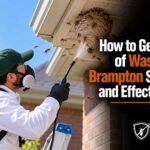

ou step out onto the deck with a coffee, and a wasp bumps against the screen. Then you notice a steady line of them slipping into a gap beside the soffit.
The safest way to get rid of wasps is to find the nest, treat it at dusk with a Health Canada registered product (or have a pro do it), and then seal the entry point. If the nest is in a wall, an attic, the ground, or somewhere high, wasp removal Brampton professionals are the safer call. One wrong move can bring dozens of stings.
Timing matters too. Wasps peak around July, when their nests are at their biggest and still growing, and they stay active until cold weather ends the colony. At The BS Pest Control, we are based in Brampton, and this guide covers what works, what does not, and when to call us.
Key Takeaways
- Treat a wasp nest at dusk or after dark, when most of the colony is inside.
- Never block the nest entrance, and never poke a nest. Both can send wasps into your home or onto you.
- Nests in walls, attics, or the ground, large nests, and nests near allergic people need a professional.
- Wasps can sting more than once, and some people have severe allergic reactions. Call 911 if someone has trouble breathing or swelling in the face or throat.
- Old nests are not reused. Sealing gaps and checking early in spring is how you stop a new nest.
- Wasp control Brampton pricing depends on the nest type, location, and how hard it is to reach. A free quote tells you the cost up front.
Table of Contents
- What Is the Safest Way to Get Rid of Wasps?
- Which Wasp Do You Have: Yellowjacket, Hornet, or Paper Wasp?
- When Should You Call a Wasp Exterminator in Brampton?
- What Does Professional Wasp Nest Removal in Brampton Involve?
- Is It Too Late in the Year to Deal With Wasps?
- How Much Does Wasp Removal Cost and How Do You Choose a Company?
- FAQs
- Conclusion
What Is the Safest Way to Get Rid of Wasps?
Treat the nest at dusk, from a distance, with a registered product, and wear protective clothing. This works only for small, easy-to-reach nests that are out in the open.
Here is the basic plan:
- Find the nest in daylight. Watch where the wasps fly in and out, from a safe distance. Do not get close.
- Check your household. If anyone is allergic to stings, stop here and call a professional.
- Wait until dusk or after dark. Most of the colony is in the nest and calmer then.
- Cover up. Wear long sleeves, long pants, gloves, and a hat or hood. Tuck pants into socks.
- Use a registered product. Pick one with a Health Canada Pest Control Product (PCP) number, and follow the label.
- Spray from a distance. Use a product made for the job, and have an exit route planned.
- Check the next day. If you still see activity, call a pro instead of repeating the treatment.
- Remove the nest after activity stops. Seal it in a bag and throw it out.
Never block the entrance of a nest in a wall. Trapped wasps often chew toward the light, and that can mean your living space. Also skip gasoline, fire, and water. They are dangerous and do not work.
What should you do if someone is stung?
Move away from the nest right away, because wasps can sting more than once. Wash the area, and use a cold pack for swelling. Most reactions are mild and fade in a day or two.
Call 911 right away if there is itching or hives over the body, swelling of the face, tongue, or throat, trouble breathing, a hoarse voice, dizziness, or stomach cramps. Use an epinephrine auto-injector if the person has one. Swelling larger than about 10 cm (4 inches) around the sting can also be a warning sign.
Which Wasp Do You Have: Yellowjacket, Hornet, or Paper Wasp?
Check the nest shape and where it is. Each type builds differently and reacts differently when disturbed.
| Wasp | Nest looks like | Where you find it |
| Yellowjacket | Hidden nest with one small entry hole | Underground, in walls, woodpiles, decks, hollow trees |
| Bald-faced hornet | Grey, paper-like ball, can grow to the size of a football | Hanging from trees, eaves, and shrubs |
| Paper wasp | Open, umbrella-shaped comb on a single stalk | Under eaves, window frames, porch ceilings |
Yellowjackets are the ones most likely to surprise you. Their nests are often hidden, and lawn mowers set them off. Bald-faced hornets guard their big nests closely and will sting if you get near.
If you cannot tell what you have, do not go closer to check. Take a photo from far away or ask a professional.
When Should You Call a Wasp Exterminator in Brampton?
Call a pro if the nest is hidden, high up, large, close to your door, or if anyone nearby has a sting allergy. Those are the cases where DIY goes wrong.
Call a wasp exterminator Brampton residents trust when:
- The nest is inside a wall, attic, soffit, or chimney
- The nest is underground
- The nest is above a ladder-height reach
- You see more than one nest
- Someone in the home has a known sting allergy, or has had a bad reaction before
- Kids or pets play near the nest
- You have already tried a spray and the wasps are still there
- The nest is near a door, a window, or a walkway you use daily
Professionals also bring the right gear and training. That means fewer stings, no panic on a ladder, and a better chance that the whole nest is treated, not just the outside.
What Does Professional Wasp Nest Removal in Brampton Involve?
It involves identifying the wasp, locating every nest, treating at the right time, removing the nest, and sealing the entry point. The goal is to solve the problem, not just move it.
- Inspection. A technician finds the nest, checks for more, and identifies the wasp type.
- Plan. The team picks the treatment based on the nest location and size.
- Treatment. The nest is treated at the right time of day, often at dusk, using the right products and gear.
- Nest removal. Once activity stops, the nest is taken down. This is especially important in walls and attics, where old paper and dead wasps can attract other pests.
- Sealing and advice. The team closes gaps and points out what attracts wasps on your property.
Our wasp control service removes wasp nests from walls, roofs, and outdoor areas. Good wasp nest removal Brampton work covers all of those steps, not just the spray.
If your wasp problem turns out to be part of a bigger pest issue, our pest control team can check the whole property.
Is It Too Late in the Year to Deal With Wasps?
It is late, but there is still work to do. In fall, the workers, the males, and the old queen die off as the weather turns cold. Old nests are not reused the next year.
Here is what that means for you right now:
- Active nests near your home can still sting until a hard frost ends the colony. Treat them if people use that area.
- Abandoned nests do not need emergency action. Remove them once you are sure there is no activity, so you can see the damage and check for gaps.
- New queens survive the winter in sheltered spots, then start new nests in spring.
Fall and winter are the best time to prevent next year’s nests. Do these jobs now:
- Seal gaps around soffits, vents, and siding.
- Fix holes in screens and loose boards.
- Fill holes in the ground around the yard and deck.
- Clear woodpiles and old debris near the house.
- Plan a spring check for small, golf-ball-sized nests. Queens build those first.
Small nests are easy to deal with. A queen starting alone is far less trouble than a colony of thousands in July.
How Much Does Wasp Removal Cost and How Do You Choose a Company?
There is no flat price, because every nest is different. Most companies quote after hearing where the nest is and what type it is. A few things set the price:
- Nest type and size
- Location: ground level, high roofline, or inside a wall
- Number of nests
- Whether nest removal and sealing are included
- Follow-up visits
A good wasp removal Brampton company explains the price before the job and tells you if a return visit is needed. Compare what is included, not only the number.
Use this checklist:
- License and insurance. Ask for proof.
- Registered products. The company should use approved products only.
- Treatment timing. Ask when they treat and why.
- Nest removal and sealing. Check if these are in the quote.
- Fast response. Wasps near a door cannot wait a week.
- A guarantee. Know what happens if the wasps come back.
The BS Pest Control is licensed and insured, uses eco-friendly methods, offers same-day or next-day service in most areas it serves, and stands behind its work with a satisfaction guarantee. Quotes are free.
FAQs
What is the best time of day to treat a wasp nest?
Dusk or after dark. Most of the colony is inside the nest then, and they are calmer. Use a light that does not shine straight at the nest, and keep an escape route clear.
Will wasps leave on their own?
Eventually. The colony dies off in fall, and the nest is not reused. But until then, the nest keeps growing and the wasps defend it. If it is near a door, deck, or play area, do not wait.
Do I need to remove an old wasp nest?
Not right away. An abandoned nest will break down on its own. Still, many people take it down once they are sure it is empty, so they can check for gaps and damage. New queens can build a fresh nest nearby.
Do wasps come back to the same spot every year?
Not to the same nest, but queens often choose similar sheltered spots, sometimes close to an old nest. Sealing gaps in fall or winter is the best way to stop them.
How do I know if wasps are nesting in my wall?
Look for steady wasp traffic into a small hole in the siding, soffit, or brick. You may also hear buzzing or scratching inside the wall. Do not block the hole. Call a professional for wasp control Brampton homes can rely on.
Conclusion
A wasp nest does not stay small. By midsummer it can hold thousands of wasps, and by fall it is a sting risk near your door. Wasp removal Brampton homeowners can trust treats the nest at the right time, removes it, and closes the gap so next year starts clean.
Do not wait for the next sting. Call The BS Pest Control at +1 (437) 329-4500, message us on WhatsApp, or request your free quote today.